
Manta Mode Blog
The Night Shift: Why Your Brain Cells Shrink While You Sleep
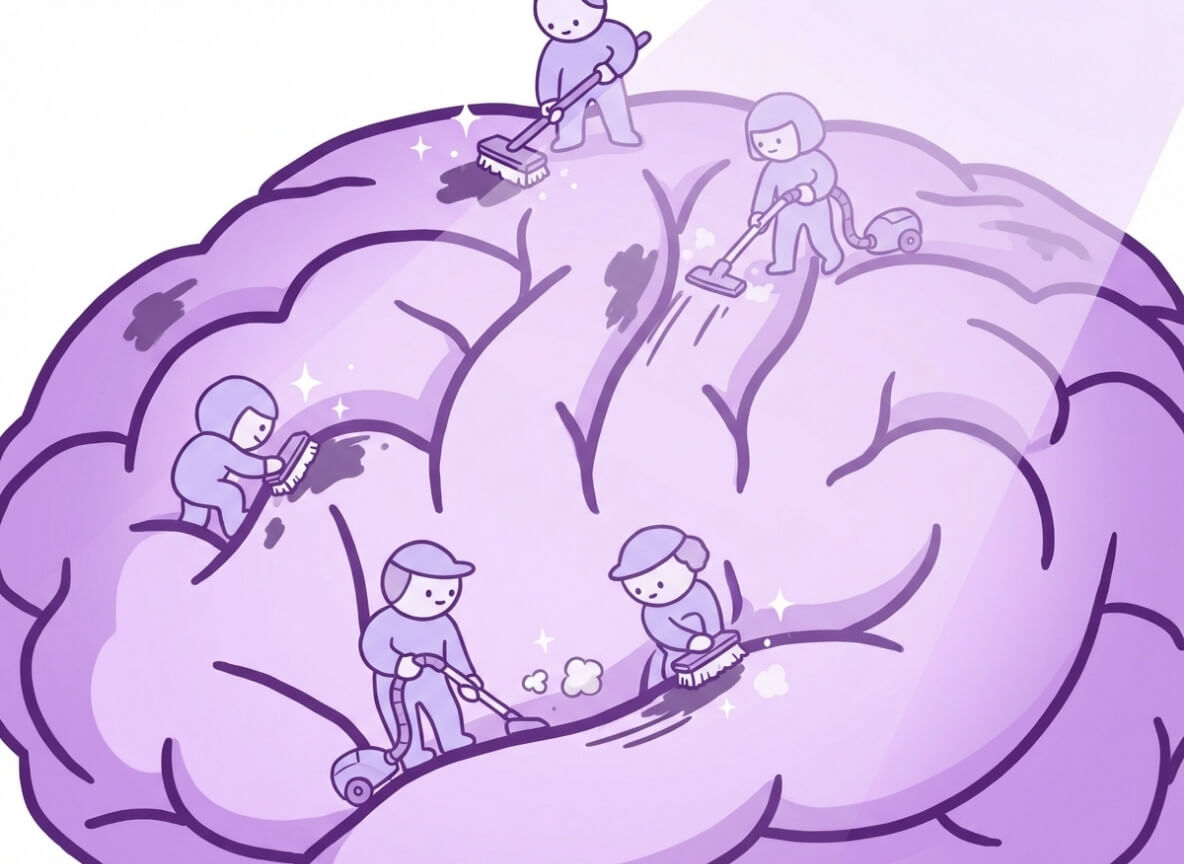
Here’s something crazy: Every night when you go to sleep, your brain cells literally shrink.
They physically get smaller, by about 60 percent, to make room for a massive cleaning operation that happens while you’re drooling on your pillow.
Your brain has a janitorial crew. It works the night shift. And it’s amazing.
Your Brain’s Secret Waste Management System
Let’s talk about the glymphatic system, which is probably the coolest thing you’ve never heard of.
All day long, your brain is working hard. Neurons are firing, information is processing, and you’re doing important things like remembering where you put your keys and pretending to listen in meetings.
But all that activity creates waste, metabolic byproducts, toxic proteins, cellular garbage. Your brain accumulates a lot of junk throughout the day. One of those nasty bits of trash is called amyloid-beta, which tends to clump together and is linked to Alzheimer’s disease.
So how does your brain get rid of it?
Enter the glymphatic system. Think of it as your brain’s personal power-wash service, except instead of showing up with a truck and a high-pressure hose, it uses cerebrospinal fluid (CSF), the clear liquid that surrounds your brain and spinal cord.
During the day, your brain cells are packed pretty tightly together. There’s not much room for fluid to flow between them. But when you sleep, those cells shrink down, creating channels and pathways for CSF to rush through and flush out all the metabolic garbage that’s been piling up.
It’s like your brain cells are stepping aside to let the cleaning crew through.
The Mechanics: How Does This Even Work?
Okay, so what’s actually happening at a cellular level to make this shrinkage possible?
When you’re awake, your neurons are busy. They’re firing signals, processing information, and burning through oxygen and glucose like they’re training for a marathon. Blood is pumping through your brain at full capacity to deliver all that fuel.
But when you fall asleep, your neurons quiet down. The party’s over. The lights dim.
With less neural activity, your brain needs less oxygen. Blood flow decreases, which drops the pressure inside your brain. And here’s where it gets cool: CSF rushes into the space and maintains safe pressure levels.
Your brain cells shrink to accommodate this fluid influx. The space between cells, the interstitial space, expands by a huge amount.
Suddenly, there’s room for CSF to flow freely through brain tissue like a river washing through a canyon.
And the glymphatic system kicks into high gear. During sleep, it becomes almost 10 times more active than when you’re awake.
That CSF is moving through your brain, picking up toxic waste products, amyloid-beta, tau proteins, and all the other cellular trash that accumulated during the day. Then it carries that junk out through a network of vessels and eventually dumps it into your lymphatic system, where it gets cleared from your body.
Your brain is literally taking out the trash while you sleep.
Why Your Brain Can’t Do This While You’re Awake
You might be wondering: Why can’t the brain just clean itself during the day?
Great question. Turns out, the brain has to choose between processing information and cleaning house. It can’t do both at the same time.
When you’re awake, your neurons are firing, your brain cells are fully expanded, and the interstitial spaces are narrow. There’s just not enough room for CSF to flow through effectively. Plus, all that neural activity generates electrical signals and metabolic demands that would interfere with the waste clearance process, not to mention making more waste.
Sleep is when your brain gets to switch modes. Neurons go quiet. Blood flow decreases. Cells shrink. And the cleanup crew gets to work.
Your brain does the “thinking and doing” shift during the day, and the “maintenance and repair” shift at night.
Kind of genius, actually.

What Happens When You Skimp on Sleep?
Sleep experts (like Matthew Walker who talked about this on Diary of a CEO) point out something annoying but useful: the deep cleaning doesn’t kick in the second you pass out.
Your brain’s cleanup crew ramps up later in the night, and it gets way more effective toward the tail end of your sleep, starting around the third sleep cycle.
Translation: if you’re constantly cutting the last chunk of your night short (hello, doomscrolling / early alarms / “just one more episode”), you might be skipping the part where the cleaning crew is finally in full power-wash mode.
And this is why adding even 10–20 minutes to the end of your night can punch above its weight.
It’s not just “more sleep is good” (true), it’s that the timing matters — those last minutes can land right when the glymphatic system is in high gear, clearing out more of the junk your brain collected all day.
So if you can only make one tiny sleep upgrade, try this: protect the end of your sleep like it’s a VIP section. Your brain’s janitors are finally rolling in with the industrial-strength stuff.
So what happens if you don’t give your brain enough time to run its cleaning cycle?
All that metabolic waste starts to pile up. The toxic proteins don’t get cleared out. Amyloid-beta accumulates in your brain tissue. And over time, that buildup is linked to cognitive decline, memory problems, and neurodegenerative diseases like Alzheimer’s.
There’s research suggesting that chronic sleep deprivation might actually increase your risk for these conditions because your brain isn’t getting enough time to flush out the garbage.
Think of it this way: If you never took out the trash in your house, eventually you’d be living in a landfill. Your brain works the same way. It needs that nightly cleanup session to function properly.
And it’s not just about avoiding disease. Even in the short term, when you don’t sleep enough, you feel foggy, slow, and mentally sluggish. That’s partly because your brain is still carrying around yesterday’s trash.
The Science is Still Unfolding
Now, fair warning: This is relatively new science. The glymphatic system was only discovered in 2012 by researchers at the University of Rochester.
Some scientists have questioned the findings about cell shrinkage during sleep, and there’s still debate about the exact mechanisms at play. But the general picture that sleep is essential for clearing waste from the brain is pretty well supported.
Researchers are still figuring out all the details. How exactly do the cells know when to shrink? What triggers the glymphatic system to ramp up? Are there ways to optimize this process? In fact, some researchers recently pointed out that wakefulness might be better for clearance because the brain is more active. So details are still being hashed out scientifically.
The answers are still coming. But what we know so far is already mind-blowing.
Why This Matters (Beyond Just Being Cool)
Look, you don’t need to understand the glymphatic system to know that sleep is important. We’ve all felt the difference between a good night’s sleep and a crappy one.
But there’s something satisfying about knowing why it matters at a cellular level.
Your brain isn’t just “resting” when you sleep. It’s actively working reorganizing memories, consolidating learning, repairing cells, and yes, shrinking itself down to let the cleaning crew through.
Sleep isn’t optional maintenance. It’s essential biological housekeeping.
The fact that your brain has evolved this intricate system: where cells physically change size to make room for a fluid-based waste removal process: is pretty dang cool.
Your brain is a weird, wonderful, surprisingly well-designed meat computer.
And every night, it runs a full system scan and cleanup operation while you’re completely unconscious.
That’s the kind of thing that makes you want to high-five evolution.
The Bottom Line
Your brain cells shrink by about 60 percent when you sleep. That shrinkage creates space for cerebrospinal fluid to flow through and wash out toxic waste. The glymphatic system becomes up to 10 times more active during sleep, clearing out metabolic byproducts that accumulate during the day.
It’s not just “beauty sleep.” It’s your brain’s version of taking out the trash, scrubbing the floors, and resetting for the next day.
So the next time someone tells you they’ll “sleep when they’re dead,” you can let them know their brain cells are literally begging for a chance to shrink and clean up and the dead part will probably come quicker without proper sleep.
Because that nightly power-wash? It’s kind of non-negotiable.
My philosophy is that you have to experiment to find what works for you. So go ahead—try something a little uncomfortable, kiss a few frogs, and see what sticks. Happy experimenting!


New to Manta Mode?
Start with these Posts To Get Your Bearings

The Manta Mode Raccoons: A Field Guide
Manta Mode Blog The Manta Mode raccoons: A Field Guide Meet the Crew Welcome to…

SPARK 101: The Overview
Manta Mode Blog SPARK 101: The Overview If you’ve been hanging around Manta Mode for…

Confessions of a Weirdo: Why I’m Not Here to Save You
Manta Mode Blog Confessions of a Weirdo: Why I’m Not Here to Save You A…






Home
Take the Quiz
SPARK Foundation
Rewrite the Filter
About Us
Blog
Shop
Community
Newsletter Archive
Contact Us
Contact Info
Email: hello@mantamode.com
Phone: (858) 283-5319
Mailing address:
4079 Governor Drive #5058
San Diego, CA 92122

@Manta Mode | All Rights Reserved
Privacy Policy | Terms & Conditions