
Manta Mode Blog
The Manta Mode raccoons: A Field Guide
Meet the Crew
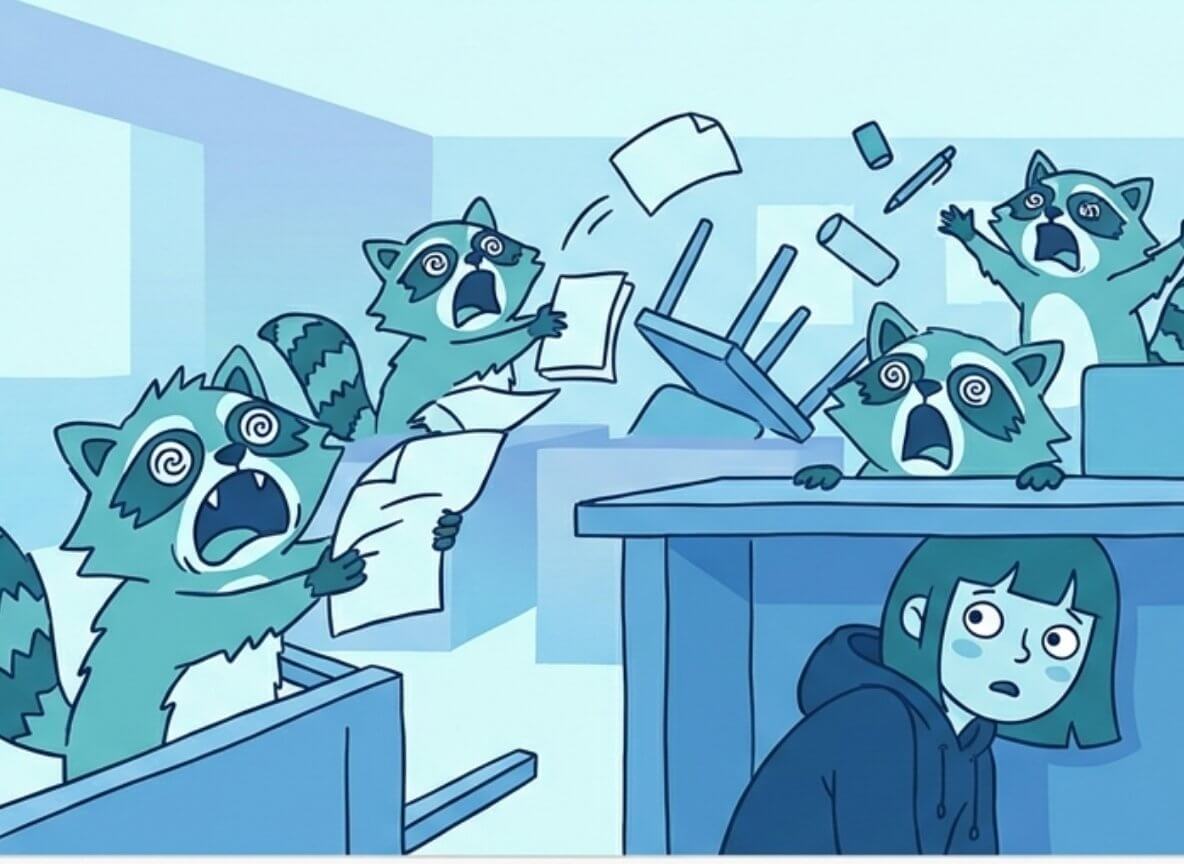
Welcome to the Manta Mode universe: Doug (your brain/the manager), the Raccoons (your stress scripts), and the Filter (the smudgy lens that decides what feels like “danger” today).
This post is your Field Guide. These are the metaphors for the things I talk about. So here are the basics: here are the creatures, here’s what they do, and here’s how to stop them from stealing your snacks.
If you’re going to hang out here, you should probably know who’s who.
The Raccoons
These are the rather dramatic, chaotic, trash-loving parts of your brain that absolutely thrive on drama. They’re the ones with the megaphones, the critic film reels (endless highlight videos of your worst moments), and the “I’m not good enough” beat up sticks.
They’re the ones screaming:
- “CHECK YOUR PHONE AGAIN.”
- “EAT THE ENTIRE BOX OF COOKIES.”
- “THEY DEFINITELY HATE YOU.”
- “YOU SHOULD PANIC ABOUT THAT THING FROM 2019.”
- “ROLL THE TAPE: HERE’S EVERY TIME YOU’VE EVER BEEN EMBARRASSING.”
- “BONK. YOU’RE NOT GOOD ENOUGH.”
Raccoons are not evil. They’re not even wrong, necessarily. They’re just loud. (And really committed to the bit.)
They operate on urgency rather than accuracy.
Their job is to keep you alive. But their definition of “alive” includes “never uncomfortable” and “always in control,” which, newsflash, is not actually possible.
So they overreact. A lot.
Doug (The Brain)
Doug is your brain. He’s the manager who’s supposed to be running the operation.
But here’s the problem: Doug is very easily overwhelmed… especially when he’s being screamed at through raccoon megaphones and whacked with “you’re not good enough” sticks.
So when the raccoons start up, Doug doesn’t step in like a calm manager and say, “Hey, let’s assess this logically.”
Nope.
Doug panics. He freezes. He hides under the desk. (Because if a pack of loud trash goblins was running your office and playing your inner-critic film reels on loop, you’d probably crawl under a desk too.)
And then you’ve got full-on chaos: every alarm going off at once, every drawer pulled open, every file scattered across the floor.
Doug means well. He’s just not great under pressure.
The 4 Common Types of Raccoons
Not all raccoons wear the same tiny trash hat. Most of us have a default crew that shows up in predictable situations and start doing their thing like it’s a paid gig. (It is. Your nervous system hired them.)
Here are the four types you’ll see in the Manta Mode Default Stress Type quiz results:

1. The Amped Raccoon (The Over-Functioner)
This one hits the gas, opens 57 tabs, and tries to out-run stress with motion.
If Doug even sniffs uncertainty, Amped Raccoon is like: “AAARRGHH. Let’s panic-fix it. Now. With spreadsheets.
What it sounds like:
- “If I just handle it all, we’ll be fine.”
- “We can’t relax until everything is solved.”
- “Move faster. Do more.”
What it makes Doug do:
- Over-function
- Control-grip the plan.
- Mistake motion for safety (busy ≠ calm)

2. The Critic Raccoon (The Prosecutor)
This is the internal roast set. It whacks Doug with “you’re not good enough” sticks and fires up the critic film reels showing you all your worst mistake replays from the last decade, now in 4K.
What it sounds like:
- “Exhibit A: you messed up in 2016.”
- “You should’ve said it differently.”
- “You’re behind and everyone can tell.”
What it makes Doug do:
- Shrink
- Over-apologize
- Try to earn relief by self-punishment (spoiler: this doesn’t work)

3. The Heated Raccoon (The Bouncer)
This one is spicy, snappy, and ready for a fight.
It’s trying to protect Doug from feeling disrespected or small, so it stands at the door like: “Just TRY Me. Hold me back. I’m on you, buddy.”
What it sounds like:
- “Say it. Say it back.”
- “If we don’t come in hot, we’ll get walked on.”
- “They can’t talk to us like that.”
What it makes Doug do:
- Get sharp, defensive, or reactive.
- Read disrespect into everything, even neutral or positive stuff.
- Blow up a whole room to avoid feeling vulnerable.
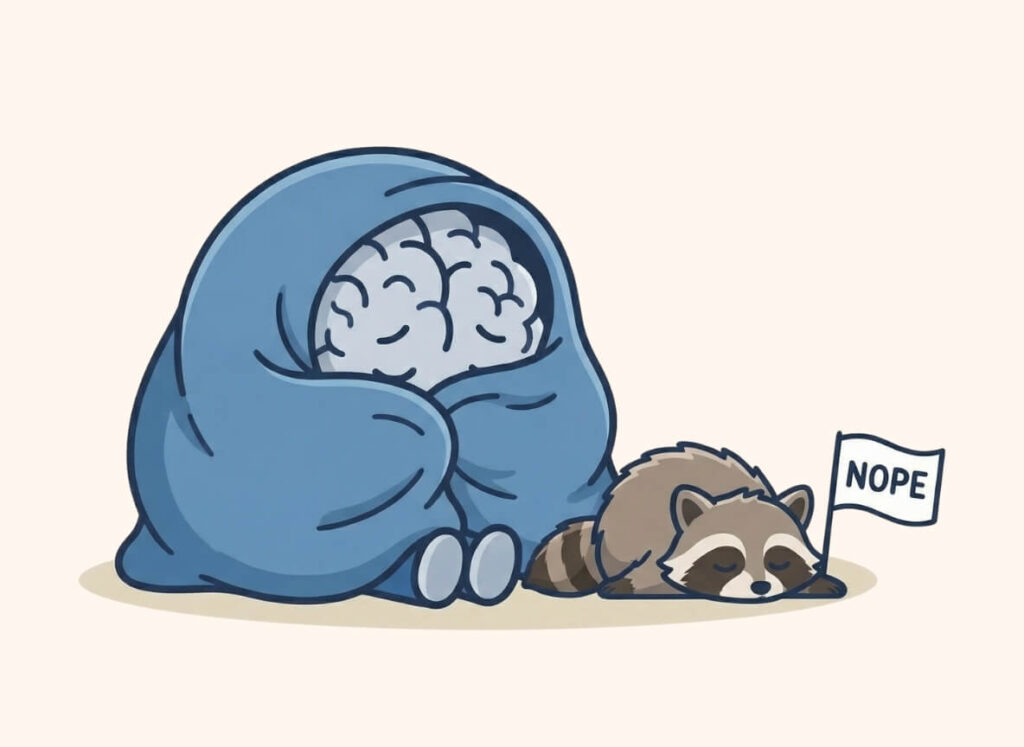
4. The Shutdown Raccoon (The Turtle)
This one turns the lights out.
When things feel like Too Much, it drags Doug into the bunker: foggy brain, doomscrolling, canceling plans, and “turtling” under a blanket.
What it sounds like:
- “Nope. Can’t. Not today.”
- “If we disappear, we don’t have to feel this.”
- “Just… shut it all down.”
What it makes Doug do:
- Freeze
- Avoid
- Go offline (mentally and sometimes literally)
Each of these raccoons thinks it’s helping. It’s just… using the tools it has.
Putting Out the Trash Panda Fires
Your worst strategy is to argue with a screaming raccoon. Because raccoons love conflict. They hear “NO” and go, “Great, we’re doing this now,” and turn the volume up to jet engine. So first you have to put out the raccoon fires.
This is the Space part of the SPARK method, creating a pocket of calm.
Space is what stops Doug from getting dragged back under the desk while the raccoons run the office with megaphones and film reels. You’re not “solving” the problem yet. You’re just creating enough breathing room to go: “Ohhh. This is a raccoon.”
And that’s often the difference between:
- a 30-second wobble, and
- a 3-hour spiral with doomscrolling for dessert.
Why Naming Your Patterns Matters (SPARK Step 2: Pattern Awareness)
In the Manta Mode universe, naming the pattern isn’t just cute branding. It’s step 2, pattern awareness.
Step 1 (Space) is where you get the raccoons calmer and Doug out from under the desk so he can think.
Step 2 (Pattern Awareness) is where you call it what it is.
It’s: “Oh. This is a raccoon.”
Naming the raccoon helps you understand how and where the raccoons are getting into your house or the dumpster. Ideally, once you know where they’re getting in, you can take some measures to keep them out or at least have an idea where to look for them when you start to spiral and have a First-Thing-To-Do in your pocket when you see them.
Now, one thing to know is that you probably have a default stress response to when the raccoons show up. Knowing what your default is helps you choose the tools that work better for the various kinds of stress responses.
While you can grab a random tool and hope it works (classic Doug move), you might end up throwing water on a grease fire (and if you didn’t know, throwing water on a grease fire causes a violent explosion, throwing flames all over your kitchen. Congratulations – you went from a small fire to your kitchen burning down your whole house – definitely not ideal.) So, by knowing your own defaults, you can use the proper tools for the situation.
You can stop being the chaos by knowing your brain’s predictable stress move:
- Amped needs to release the excess energy.
- Critic needs you to give your brain a different job.
- Heated needs a de-escalation tactic.
- Shutdown needs a gentle reassurance that you’re okay.
Knowing what type (or types) you are helps you to stop feeling like you’re the mayhem. You become the person observing the chaos and picking the next move on purpose. You can’t manage what you can’t see. And you can’t see it if you think it is you.
How to Spot Your Own Raccoons
Okay, so you’re sold on the metaphor. Great. Now what?
Here’s how to start identifying your raccoons in real time:
1. Notice the Volume Spike
Raccoons don’t whisper. They scream. If a thought feels urgent, loud, and like it needs to be solved right now or else, that’s probably a raccoon.
Real problems don’t usually sound like that. Real problems sound more like, “Hmm, I should probably deal with this soon.”
Raccoons sound like, “IF YOU DON’T FIX THIS IMMEDIATELY, EVERYTHING WILL FALL APART.”
2. Check for the Loop
Raccoons love reruns. If you’ve thought the same thought 47 times today, you’re not solving a problem. You’re stuck in a raccoon loop. Your brain thinks if it just reviews the situation one more time, it’ll finally figure it out.
Spoiler: It won’t.
3. Look for the “Always” or “Never”
Raccoons deal in absolutes.
- “I always mess things up.”
- “Nobody ever listens to me.”
- “This never works out.”
Real life doesn’t work in absolutes. But raccoons don’t care about nuance. They care about drama.
4. Feel the Physical Reaction
Raccoons aren’t just loud. They’re physical.
They’ll give you:
- A tight chest
- A racing heart
- The shakes
- The “I need to move/fix/do something RIGHT NOW” feeling.
If your body is revving up like you’re about to fight a bear, but you’re actually just sitting at your desk thinking about an email… that’s raccoons.
5. Notice What They’re Protecting
This is the big one. Raccoons aren’t random. They’re strategic. They’re usually trying to protect you from something: rejection, failure, uncertainty, feeling out of control, being judged. So when you spot a raccoon, ask: What is this trying to keep me safe from?
Because once you know that, you can have an actual conversation with it instead of just white-knuckling your way through.
So here’s a weirdly effective move: invite the raccoon responsible for this particular mayhem to a tea party.
Curiosity creates distance. And distance helps you gain a better perspective.
You’re basically saying: “Okay, little guy. Sit down. Tell me why you’re yelling.” At the tea party, you don’t debate. You listen.
Try these questions:
- Why are you screaming right now?
- What are you trying to protect me from?
- What’s the worst-case scenario you’re trying to prevent?
- What do you think will happen if I don’t fix this immediately?

The Goal Isn’t to Kill the Raccoons
Let’s be clear: You will never get rid of the raccoons. They’re part of the system. They live here. But you can learn to:
- Recognize when they’re running the show.
- Create space between their noise and your choices.
- Talk back to them with actual data instead of just reacting.
Rather than aiming for perfection or Zen master level calm and enlightenment, you just need to get better at noticing, “Oh, that’s a raccoon.” Because when you can see the pattern, you can interrupt it. And when you can interrupt it, you get your agency back.
And that’s when things start to shift.
Next time your brain starts yelling: Pause. Take a breath. And ask yourself, “Is this me? Or is this the raccoons?”
You might be surprised how often it’s the raccoons.
Curious what your default stress type is? Take the Default Stress Type Quiz to find out and get your First-Thing-To-Do.
___
My philosophy is that you have to experiment to find what works for you. So go ahead: try something a little uncomfortable, kiss a few frogs, and see what sticks. Happy experimenting!

New to Manta Mode?
Start with these Posts To Get Your Bearings
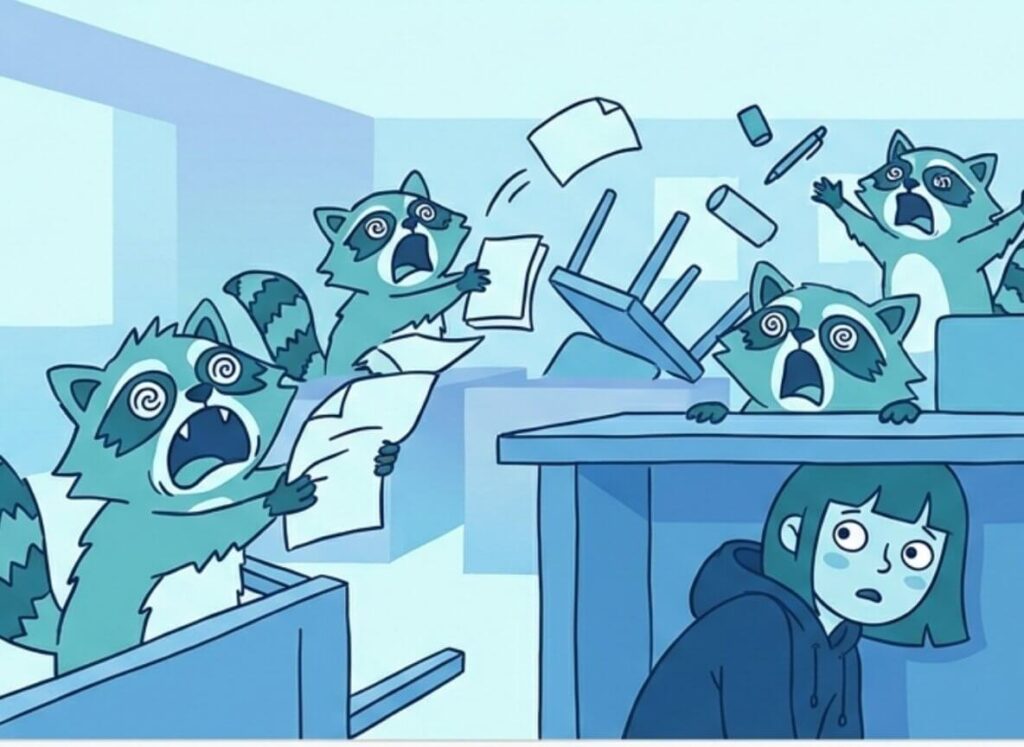
The Manta Mode Raccoons: A Field Guide
Manta Mode Blog The Manta Mode raccoons: A Field Guide Meet the Crew Welcome to…

SPARK 101: The Overview
Manta Mode Blog SPARK 101: The Overview If you’ve been hanging around Manta Mode for…

Confessions of a Weirdo: Why I’m Not Here to Save You
Manta Mode Blog Confessions of a Weirdo: Why I’m Not Here to Save You A…






Home
Take the Quiz
SPARK Foundation
Rewrite the Filter
About Us
Blog
Shop
Community
Newsletter Archive
Contact Us
Contact Info
Email: hello@mantamode.com
Phone: (858) 283-5319
Mailing address:
4079 Governor Drive #5058
San Diego, CA 92122

@Manta Mode | All Rights Reserved
Privacy Policy | Terms & Conditions